The Renewable Material Footprint: Drop-in Textiles for Decommissioned Turbine Blades
Wind Energy's Credibility Crisis at the End of the Blade
Wind power is the backbone of the global energy transition. Global cumulative wind capacity reached 1,136 GW by end of 2024, and the IEA projects wind and solar together will supply roughly 70% of global electricity by 2050. By almost every measure, wind is a climate success story.
But a quieter story is emerging in parallel — one that risks undermining wind energy's social licence if left unaddressed.
Wind turbine blades are built to last 20–25 years. First-generation turbines installed in the late 1990s and 2000s are now reaching end of life at scale. The Global Wind Energy Council projects annual blade waste will rise from roughly 10,000 tonnes in 2025 to approximately 110,000 tonnes by 2030 — a tenfold increase in five years. By 2050, some estimates put cumulative global blade waste at over 43 million tonnes.
The composites that make blades so effective — primarily glass fibre-reinforced polymers (GFRP) bonded with thermoset epoxy resins — also make them extraordinarily resistant to recycling. Unlike the steel towers, copper wiring, or concrete foundations of a turbine (roughly 90% of the total mass, all recyclable via standard practices), blades represent the last unsolved material problem in wind. Under business-as-usual, the US National Renewable Energy Laboratory (NREL) estimates up to 78% of decommissioned blades will end up in landfills.
The Regulatory Inflection Point
The European wind industry introduced a self-imposed landfill ban for decommissioned wind turbine blades effective 1 January 2026 — a voluntary industry commitment WindEurope is calling on the EU to enshrine in law. France leads the regulatory charge: since January 2025, at least 55% of rotor blade mass must be recycled or reused (up from 45% in 2023 and 35% in 2022). France also mandates 95% whole-turbine recyclability from January 2024. The EU's planned Circular Economy Act — expected in 2026 — is likely to extend such mandates across all member states. For manufacturers and developers, the compliance clock has started.
The reputational stakes are equally pressing. Images of thousands of blades stacked in Wyoming fields or buried in South Dakota landfills have circulated widely in mainstream media. For an industry that sells sustainability, this is not a minor optics problem — it is a structural contradiction.
Why Conventional Recycling Approaches Miss the Mark
Significant R&D effort has gone into blade end-of-life over the past decade. The three main technical pathways — mechanical, thermal, and chemical recycling — each present real limitations:
- Mechanical recycling (grinding/shredding): Cost-effective and commercially mature, but it downcycles blades into low-value aggregates suitable mainly for cement co-processing. Embedded fibre strength is largely destroyed. This does not constitute a true circular loop — it is deferred disposal.
- Pyrolysis and thermal treatment: Can recover glass fibres, but the high-temperature process (600°C+) is energy-intensive, and recovered fibres typically show degraded mechanical properties — often rendering them unsuitable for structural applications.
- Chemical solvolysis: Promising for fibre quality retention, but currently confined largely to laboratory scale. The ZEBRA consortium (Arkema, Owens Corning, LM Wind Power) demonstrated a closed-loop process for thermoplastic blades in October 2024 — a genuine advance, but dependent on next-generation thermoplastic blade designs not yet in widespread deployment.
The critical gap these methods share is the same: none of them produce a ready-to-use, performance-validated textile that can enter an existing blade manufacturing line without modifications. Recovering fibre is necessary but insufficient. What manufacturers actually need is a material they can use — today, in their existing workflows, without a science project.
The Verretex Approach: Regeneration, Not Downcycling
Verretex, the EPFL spin-off headquartered at EPFL Innovation Park in Lausanne, Switzerland, was built to address this gap directly. Rather than recovering fibres and stopping there, Verretex takes the additional step that the rest of the industry has overlooked: regenerating those fibres into finished, high-performance textiles that manufacturers can use as a direct drop-in replacement for virgin glass fibre fabrics.
How the Process Works
Verretex's proprietary process operates at the microscopic level. Rather than relying on energy-intensive remelting — the conventional approach that degrades fibre quality and generates significant CO₂ — Verretex cleans glass fibres at the molecular surface to restore their mechanical properties. The output is a nonwoven textile that is virgin-like in performance but derived entirely from end-of-life and production scrap composite waste.
This distinction matters enormously for the circular composites supply chain:
- No remelting: A recent Life Cycle Assessment by TECH-FAB Europe (via PwC) found that glass fibre production itself accounts for 89% of the carbon footprint of a final glass fibre fabric. By bypassing remelting, Verretex eliminates this dominant emissions source.
- Multi-resin compatibility: The regenerated textiles work with existing resin systems — including both epoxy and emerging thermoplastic matrices like Elium — making them applicable across current and next-generation blade architectures.
- Performance validated: Verretex's textiles have been validated in wind energy, marine, automotive, and sporting goods applications. In each case, integration required no changes to existing manufacturing workflows.
The Ryse Energy Pilot: Proof of Concept at Commercial Scale
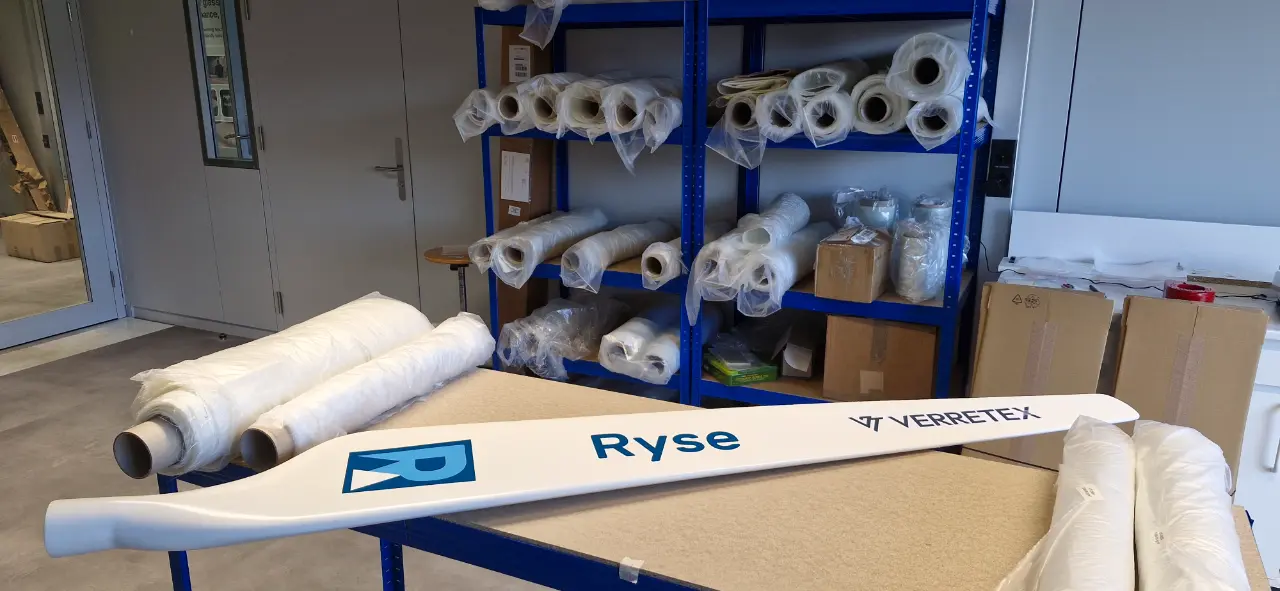
The most significant validation of Verretex's drop-in claim came through a formal pilot with Ryse Energy, a global manufacturer of small wind turbines and hybrid off-grid systems, conducted at Ryse's manufacturing facility in Castalla, Spain.
The pilot, led by Ryse's technical composite specialist Neil Baxter, demonstrated that Verretex's 100% recycled glass fibre textile could be processed using Ryse's existing blade layup and curing methods with zero tooling modifications and no cycle time changes. The resulting test blades met IEC 61400-2 standards — the international benchmark for small wind turbine safety and durability.
"Our team was able to integrate Verretex's recycled textile seamlessly, and the resulting test blades met the strength and durability requirements essential for wind turbine performance," said Baxter. "This shows the real-world potential of recycled composites in renewable energy manufacturing."
"This pilot validates Verretex as a true drop-in solution for blade makers," said Dr. Mitchell Anderson, CEO and Co-founder of Verretex. "We regenerate textiles from end-of-life and production scrap glass fibers to create virgin-like, low-carbon materials that fit existing production — no retraining, no retooling."
Following the success of the pilot, Verretex is scaling production capacity, and Ryse Energy has committed to integrating these circular materials across its global manufacturing footprint — spanning Spain, Europe, and the US — once volumes and cost targets align.
Seamless Integration: What 'Drop-In' Actually Means for Manufacturers
The phrase 'drop-in solution' is used loosely across the advanced materials sector. In the context of composite blade manufacturing, the term has a precise meaning with significant commercial consequences.
Blade manufacturing facilities represent hundreds of millions of euros in capital investment. A layup hall, an infusion system, an oven or autoclave, a quality control protocol — these are not reconfigured lightly. Solutions that require process modifications, new tooling, or retraining introduce implementation risk, capital expenditure, and production downtime that most manufacturers will not absorb for a sustainability initiative, regardless of its environmental merit.
Verretex's solution works within this reality rather than against it. The regenerated textiles are designed to behave identically to the virgin glass fibre fabrics they replace — same drape characteristics, same resin uptake, same processing parameters. The Ryse pilot confirmed this at the production level: the team used their existing layup methods without any process adjustment.
This means a wind blade manufacturer can transition to a lower-carbon, circular material supply without a capital programme. The decision sits at the procurement level, not the engineering level. For OEMs under pressure from ESG reporting requirements, investor scrutiny, and emerging regulatory mandates, this is the difference between a material they can adopt in the next procurement cycle and one that requires a multi-year integration project.
The Regulatory Signal for Procurement Teams
France mandates that at least 55% of rotor blade mass be recycled or reused as of January 2025 — part of a stepped obligation that began at 35% in 2022. France also requires 95% whole-turbine recyclability from January 2024. EU-wide blade recycling requirements are expected under the Circular Economy Act in 2026. For procurement and sustainability leads at wind energy manufacturers, sourcing materials from certified circular streams is increasingly a compliance requirement, not merely a preference.
The Circular Composites Market: Scale, Timing, and the Investment Case
The commercial opportunity in circular glass fibre composites is substantial and, critically, time-sensitive. Several converging forces are creating a narrow window of first-mover advantage:
The Volume Wave
Global blade waste is projected to rise from roughly 10,000 tonnes per year in 2025 to approximately 110,000 tonnes per year by 2030 (GWEC, 2025). This is not a distant scenario — it is the immediate consequence of first-generation turbines now reaching end of life across Germany, Spain, Denmark, and the US. Europe's annual decommissioned blade volume is expected to nearly triple by 2030, concentrated in the most mature wind markets.
Each tonne of decommissioned blade material represents both a waste liability and a raw material feedstock. Verretex converts the latter into a high-value input rather than a disposal problem.
The Regulation Cliff
Europe's self-imposed industry landfill ban took effect 1 January 2026. Legislative enshrinement at the EU level is expected to follow. For manufacturers and project developers in Europe — and for those supplying European markets — demonstrable circularity in the blade supply chain will shift from a reporting metric to a procurement requirement within this planning cycle.
The Capital Momentum
The wind blade recycling market attracted significant capital in 2024–2025: Spain's Acciona launched the Waste2Fiber thermal recycling facility in Navarre; Siemens Gamesa advanced its recyclable offshore blade programme; Veolia expanded its mechanical recycling capacity in France in partnership with EDF Renewables. The DOE's January 2025 report confirmed that existing US infrastructure can already process 90% of decommissioned turbine mass — and allocated $20 million under the Bipartisan Infrastructure Law to close the remaining 10% gap. This signals a market that is moving from R&D into commercial infrastructure.
Within this landscape, Verretex occupies a differentiated position: it is the only solution that converts recycled glass fibre into a performance-validated, directly deployable textile — not a filler, not an aggregate, not an intermediate material requiring additional processing steps. The CHF 1.2M funding round closed in early 2026 and the ongoing Venture Kick backing signals investor confidence in the commercialisation roadmap.
Closing the Loop: A Functional Circular Supply Chain for Wind Energy
The vision Verretex is building toward is not complex in principle, even if it requires precise execution at the material level. A functional circular supply chain for wind energy composites looks like this:
- Decommissioned blades are collected at end of life and routed to composite recycling infrastructure (mechanical, thermal, or chemical, depending on blade generation and composition).
- Recovered glass fibres — previously a low-value byproduct with limited reuse potential — are channelled to Verretex as a raw material feedstock.
- Verretex regenerates those fibres into high-performance nonwoven textiles with virgin-like mechanical properties.
- Those textiles re-enter blade manufacturing lines as a drop-in replacement for virgin glass fibre fabrics — processed identically, at no performance penalty.
- New blades manufactured with this material carry a measurable, certified reduction in embodied carbon, supporting OEM sustainability reporting and regulatory compliance.
This is not a theoretical model. The Ryse Energy pilot demonstrated steps 3–5 at production scale. Steps 1–2 are already operational across multiple recycling infrastructure providers that Verretex partners with for fibre offtake. The full loop is functional today. The scaling challenge is one of volume and cost — both of which improve as decommissioning rates accelerate and circular material demand from manufacturers increases.
Dr. Anderson has articulated the broader context clearly:
"Across industry, government, and society, there is growing recognition that the energy transition must also address its material footprint. Regulators, manufacturers, investors, and innovators are all under increasing pressure to close the loop on advanced materials. Verretex aims to be a critical piece of that solution — working alongside industry to transform composite waste into a high-performance resource and enable a truly circular future."
The Wind Transition Needs a Material Transition to Match
The energy transition cannot afford to produce a waste transition in its wake. Every year, the volume of decommissioned blade material accelerates. The regulatory window is closing. The reputational stakes for the wind industry are real.
Verretex has built the solution the supply chain is looking for: a regenerated glass fibre textile that enters existing manufacturing workflows without modification, carries a certified reduction in embodied carbon, and transforms a material liability into a high-performance resource.
For wind energy manufacturers, the question is no longer whether to integrate circular materials — it is which circular materials are ready to integrate today. The Ryse Energy pilot has answered that question. Verretex's textiles are ready.
Interested in integrating Verretex's circular glass fibre textiles into your manufacturing process? Contact the Verretex team at verretex.com to discuss pilot opportunities, material specifications, and supply partnerships.
Sources & References
Global Wind Energy Council (GWEC), Global Wind Energy Report 2025
WindEurope, 'Where Do Wind Turbine Blades Go When They Are Decommissioned?' November 2025
National Renewable Energy Laboratory (NREL), Blade Waste Projections 2022
TECH-FAB Europe / PwC, Life Cycle Assessment of Glass Fibre Fabrics
IEA, 'Net Zero by 2050' Scenario, 2021
CompositesWorld, 'Verretex, Ryse Energy Confirm Use of rGF Textiles as Drop-In Wind Blade Materials,' September 2025
ScienceDirect — Recycling Strategies for Decommissioned Wind Turbine Blades, February 2026
ACS Sustainable Resource Management — Environmental and Economic Assessment of Wind Turbine Blade Recycling Approaches, 2024
ACS Applied Engineering Materials — Upcycling Wind Turbine Blade Waste into High-Performance Flexible Thermal Insulation Composites, December 2025
MDPI Sustainability — Waste Management of Wind Turbine Blades, January 2025
DOE Wind Energy Technologies Office, January 2025 Policy Report
More news